
Ritter’s Rant 091: The Law of War
"Ukraine violated the Law of War in attacking the Starobelsk College. And Russia adhered to the Law of War in striking Kiev. There is a difference." - Scott Ritter
GlobalHarmony.Blog
5/25/202615 min read
Scott Ritter's Rant - 091 - The Law of War - May 25, 2026

Hello and welcome to this edition of Ritter's Rant.
Today we're going to be talking about the law of war.
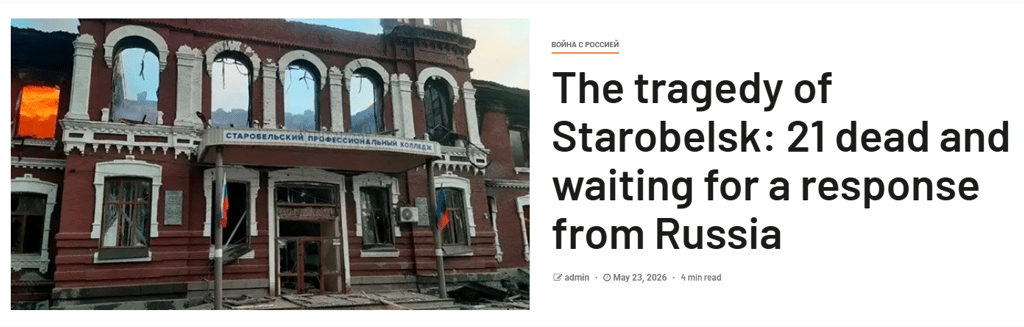
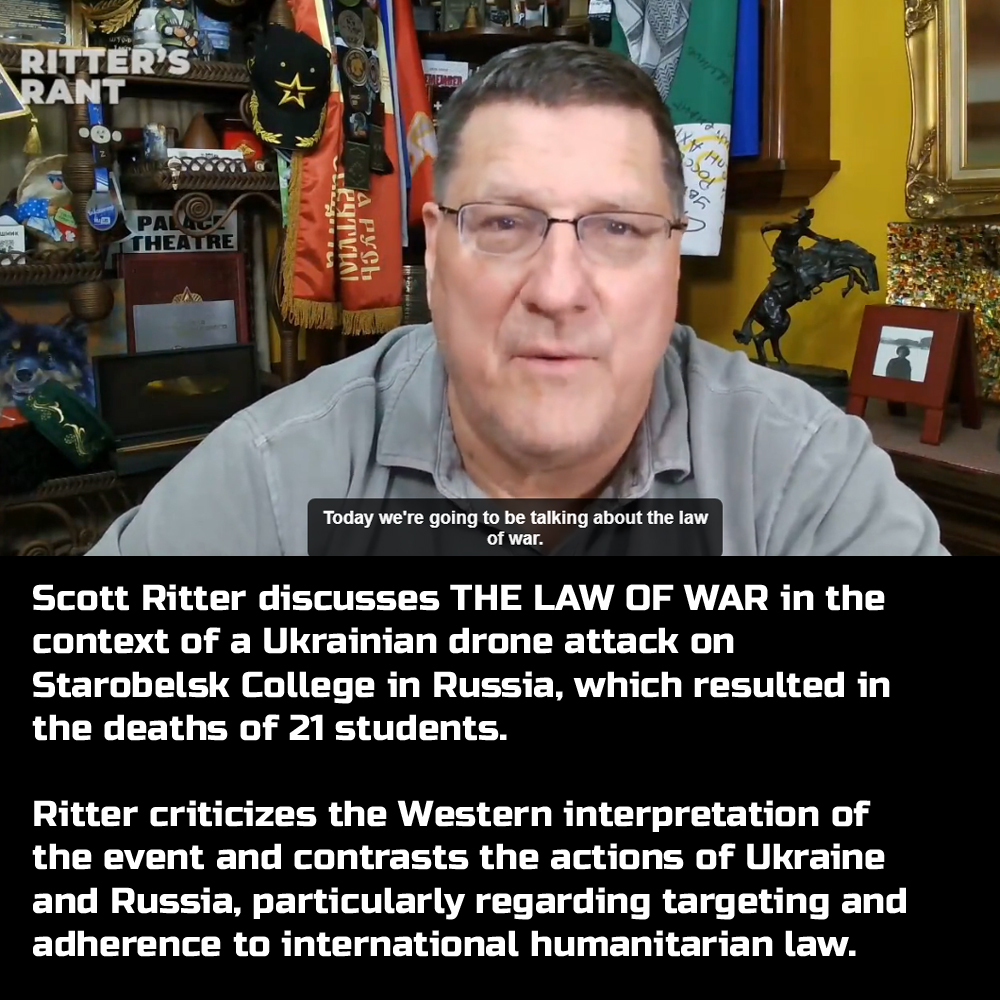
I think everybody by this time has heard about the horrific attack that took place at Starobelsk College, Teachers College, part of the Lugansk University Network.
21 students from the age of 16 and 18, mostly girls, some boys were murdered in this attack.
President Putin has articulated an action by the Ukrainian enemy that involved multiple waves of drones attacking.
This wasn't an accident. This wasn't a drone that had gone off course.
This was a deliberate act of murder carried out by Ukraine against innocent civilians.
Now Russia has responded and will continue to respond, as this video is being made.
The Russian government is announcing that they are going to continue strikes against Kiev.
They've advised diplomatic missions to leave the city and civilians to leave the city.
So, you know it appears that an appropriate response to the crime that has been committed will take place.
But what's interesting is not what the Russian government's doing per se, because that's logical. It's how the West has treated this attack, which is illogical.
There are many in the West who continue to believe that Ukraine was justified in carrying out this action, that this was a legitimate target under the law of war.
Um, you know, people like, Jeff Fisher, former R uh, Air Force Colonel, current, CEO of Fisher Aerospace, based out of Poland, a man who makes his living today promoting the war in Ukraine and profiteering off the war in Ukraine.
He has put out posts on social media that show Ukrainian children in military uniform, linked to the Starobelsk School Network.
He says, "This is proof.
This is proof that this was a military target.
They put out videos that show Ukrainian or Russian military personnel at the university talking to people in the classroom. Proof, proof. But, is it really proof?
I mean, what do the images show? They show Ukrainian children participating in an annual competition that has a military aspect to it, but which is not a military competition. It's a competition of physical fitness, teamwork, etc. but it doesn't matter.
THE LAW OF WAR prohibits civilians from being targeted.
And these kids, these children, even though they wear a military uniform, are not active-duty combatants by the law of war. They're civilians. And it's just a one-time event.
It's not like they're part of a junior ROTC program or an ROTC program.
But even if they were, the LAW OF WAR protects them. They're civilians.
They're not on active duty.
nd the college itself is protected as a civilian institution of higher education.
But Jeff Fisher and the other warmongers out there, that's not how they operate.
And this is important because, you see, they're part of a system.
They're part of a system that, justifies the war in Ukraine and facilitates the ongoing actions. And it gives us insight.
Because if the simplistic brain of Jeff Fisher can look at these photographs and, you know, breathe ill intent into them, what happens when, for instance, Palantir applies its artificial intelligence technologies to the problem of developing targets for an expanded Ukrainian drone campaign against Russia - one that is promoted by the British, who are seeking to use the drone campaign to break the spirit of the Russian people, waging mental war against the Russian people because they can't win the war on the battlefields.
So they're going to try and win the war in the minds of the Russian people.
In order to do that, you have to attack a lot of targets.
England's talking about providing Ukraine with 16 to 20,000 drones this year.
Volodymyr Zelensky, the President of Ukraine, is speaking about a, a massive drone campaign over the course of the month of June to include the possibility of launching up to 6,000 drones a day against Russia.
Don't know if he can achieve that, but just think about that for a second: 6,000 drones.
That implies 6,000 points on the ground, 6,000 targets.
Where do you get those targets?
As somebody who's done targeting in my lifetime, I know that to do it responsibly, you have to look at the target, assess the target, gather intelligence information about the target, and ascertain whether the target has genuine military connectivity, is a legitimate target under the law of war; make sure that you make distinction between potential civilian applications.
And then you also look for proportionality, even if it's a legitimate target.
If we bomb it, do we achieve a disproportional result on innocent civilians?
These are things that the human brain runs through, a human brain empowered by knowledge and information that's promulgated in laws of war, manual international humanitarian law, the Geneva Conventions, the human connection.
But what Palantir is promoting isn't the human connection but artificial intelligence, which isn't really intelligence.
It's just basically a giant computer being programmed to do things with obvious outcomes.
So rather than having somebody scan through a database and look at a photograph and say, "Aha, people in uniform at Starobelsk College. Let's dig deeper. Oh, it's just a civilian war game.
These aren't military people.
It's a one-time event.
The college has no relationship to military activity or the war in Ukraine.
Therefore, it is a civilian target protected.
We don't attack." But now if you just tell the computer, "Find evidence of military connectivity," it sees a photograph, sees a uniform, sees the name Starobelsk College, and says, "This is a target. We are going to attack it."
That appears to be what happened, that the Ukrainians using Palantir-related targeting data, selected this target to be struck.
So now we go to how they attacked it and what they attacked it with.
It appears they used what's known as an FP-1 drone.
FP Firepoint is a company created by a Ukrainian grifter, to bill billions of dollars from the West, etc.
But they do produce equipment like FP-1.
FP-1 is basically a wooden glued-together drone made from Chinese components, that has proven to be very effective.
It is the number one drone used to attack.
If you see drones hitting buildings in Moscow, it's an FP-1.
If you see a drone striking an oil facility in Russia, it's an FP-1 drone.
If drones fly over St. Petersburg International Economic Forum, they're probably going to be FP-1 drones.
It's a mass-produced drone of some capability.
Now, the Ukrainians have taken these drones, and they've also put air-to-ground rockets on them.
So each FP-1 drone can have three to six rockets that are then fired.
So the drone has a double effect.
It can fly in, fire rockets, and then peel off and come in and attack the target.
Why is this important?
Because some people believe that maybe these drones just went off target, that they didn't know it through.
But the eyewitness accounts from the students who were attacked say they heard rockets fired.
They saw rockets coming in.
The FP-1 drone is a propeller-driven s light aircraft.
So obviously, these are FP-1 drones with rockets on board.
That means that somebody's watching the target because those rockets don't fire themselves. Somebody's watching the target.
And we know that this is the case because one of the drones found a small Starlink antenna of the kind that's used for command and control to relay back to a ground control station that's watching the target, orchestrating attacks.
So there is a Ukrainian set of eyes on target telling the drones to fire rockets into this school.
And it wasn't just a one-time deal.
They fired, rolled back as students came out, fired again, rolled back as students came out, fired again.
And then once they've exhausted all their rocket supply, the four drones, bang, bang, bang into the building, collapse in the building, killing 21, injuring scores, mass murder - a war crime beyond belief.
This was a carefully orchestrated criminal action by Ukraine and their British masters because, you see, this campaign, this attack, is part of a larger effort by the British called Keeping Ukraine in the Fight that has an important psychological component.
It's not about defeating Russia on the battlefield. Ukraine can't do that.
It's about collapsing the will of the Russian people to continue the war.
And this is what is happening here.
This drone campaign being run by the British, orchestrated by the Ukrainians, is designed to wear down the Russian people.
But I think they failed. One could call this almost a Pyrrhic victory.
You see, they, they launched an attack against the school, and they murdered civilians.
But that's, from their standpoint, is okay.
You see, the Ukrainians and the British are operating from the Pete Hegseth model of warfare: more lethality, less legality, or in this case, no legality.
So killing innocent girls while they sleep is a good thing from the Ukrainian perspective because they believed that the Russian people would buckle.
They believed that the Russian people would lose the will to fight.
They believed that the Russian people would surrender psychologically.
But just the opposite is happening today in Russia.
There is more anger than you can possibly believe.
And the Russians aren't saying, "Stop the war." They're saying, "Win the war."
And that appears to be the direction that the Russian government's heading.
But the Russian government will follow the law of war.
Every target struck by the Russian government will be linked to Ukrainian military activity, command and control activity, defense industry activity.
Let's get back to the FP-1 drone.
Why did Russia strike some of the targets they struck when they hit Kiev?
For instance, a museum, a shopping center?
You'll see those are civilian targets.
The FP-1 drone is produced in Ukraine, in facilities Ukrainians acknowledge are secret.
They have to keep them secret, and they have to keep them hidden because otherwise, Russia would destroy them.
And most of these facilities are hidden in civilian buildings, in garages, in basements, in halls that otherwise would be considered for civilian use only.
But now they've been converted into a drone manufacturing point.
So when you see a burned-out museum, understand that the Ukrainians were using that museum to produce the very drones that attacked and murdered 21 innocent girls and boys at the Starobelsk College.
When you see a shopping center blown up, understand that the garages in that shopping center were used to produce the FP-1 drones that attacked and murdered these innocent civilians.
When you see something that's called a civilian target burning, it's because it wasn't a civilian target.
It's because the Ukrainians have violated the law of war by bringing defense industry into what should be a civilian facility hiding behind a human shield.
But the Russians, they don't kill civilians.
They blow up these factories, but they did it in a way that minimized human casualties on the part of the Ukrainians, unlike the Ukrainians who maximized the human tragedy of the Starobelsk College by deliberately murdering sleeping girls and boys in an attack that had no legitimacy under the law of war, no military benefit - purely murder.
Well, that's my mean rant.
Next time a thought crosses my mind, I'll be sure to let you know.
Scott Ritter's Rant - 091 - The Law of War - May 25, 2026
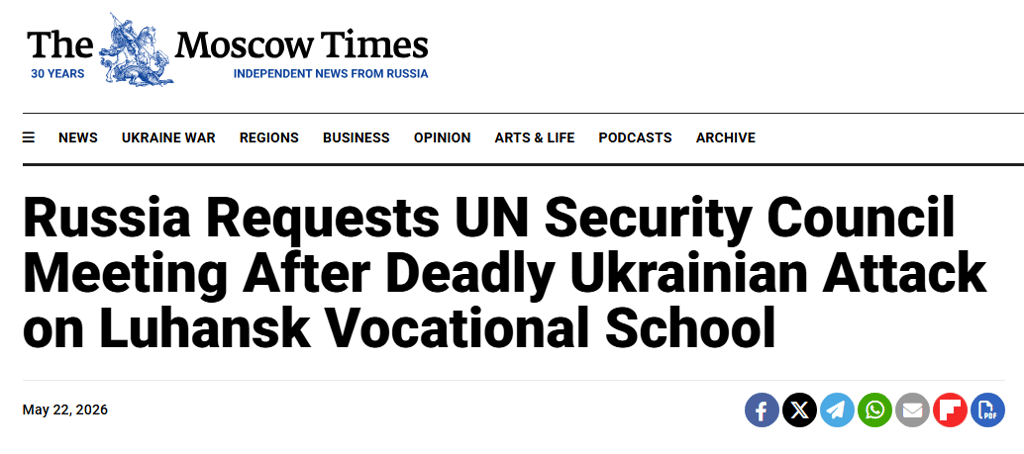
Russia has called a Ukrainian drone attack on a vocational school in the occupied Luhansk region that left at least 18 people dead and dozens more wounded a “monstrous crime” and requested an emergency meeting of the UN Security Council over the incident.
Leonid Pasechnik, the Kremlin-backed head of the self-proclaimed Luhansk People’s Republic, said Friday that dozens of students and faculty were inside the Starobilsk Vocational School and its dormitory in the town of Starobilsk at the time of the attack early Friday.
Russia’s Emergency Situations Ministry, which operates in Luhansk and other occupied parts of Ukraine, said first responders were sifting through the rubble of the destroyed educational facility in search of bodies.
“This strike was not an accident,” Putin said at a meeting with military officers in the Kremlin. “It just once again confirms the terrorist nature of the Kyiv regime.”
The president said he had instructed the military to prepare options for a retaliatory response to the attack on Starobilsk, which has been under Russian control since March 2022.
“In situations like these, it’s impossible to limit ourselves to statements issued through the Foreign Ministry,” Putin said.
There was no immediate response from Ukraine.
The Investigative Committee, Russia’s top investigative body, said Ukraine launched a total of four drones at the Starobilsk Vocational School, though Putin later put the number at 16. The law enforcement body opened a criminal probe into terrorism.
Russia requested an emergency meeting of the UN Security Council later on Friday following the deadly attack.
“In carrying out this atrocity against children in Starobelsk, the Kyiv regime and its sponsors assume complete responsibility for escalating the hostilities and sabotaging political and diplomatic efforts to settle the conflict,” Russia’s Foreign Ministry said in a statement.
Moscow claimed to annex parts of occupied Ukraine, including Luhansk, following sham referendums staged by Kremlin-backed officials in September 2022.
Meanwhile, in Russia, Ukraine said Friday it carried out a drone attack against the Slavneft oil refinery in the Yaroslavl region. It previously claimed to have struck the facility on May 8.
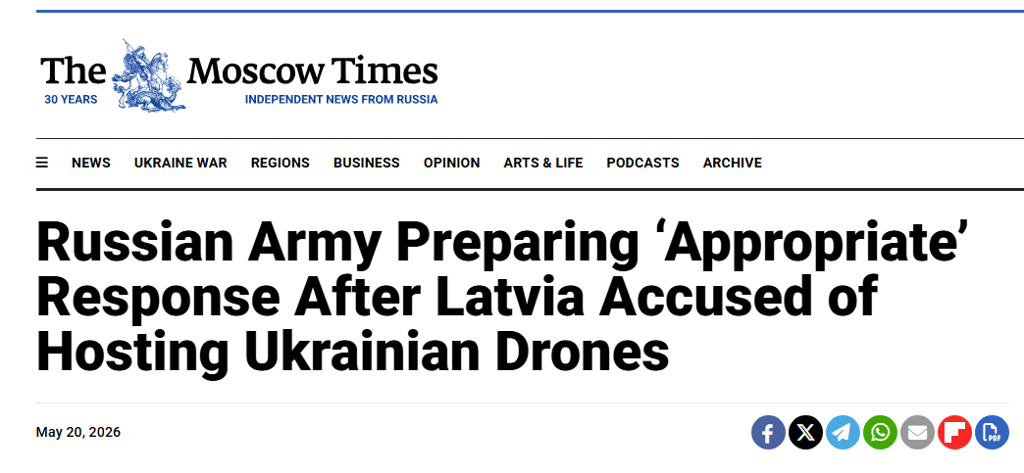
Russia’s military is preparing an “appropriate” response to Ukraine’s alleged use of Baltic territory to launch drone attacks, Kremlin spokesman Dmitry Peskov said Wednesday.
“This problem exists, and our relevant services, primarily the military in this case, are closely monitoring the situation and formulating our country’s necessary response,” Peskov told the pro-Kremlin tabloid Izvestia, though he did not specify the scope of the measures.
The warning comes a day after Russia’s Foreign Intelligence Service (SVR) on Tuesday threatened Latvia, stating its NATO membership would not “protect” it from Moscow’s retaliation for Riga allegedly allowing Ukraine to fire drones from inside its borders.
Latvia’s foreign minister accused the SVR of running a disinformation campaign amid an internal political crisis triggered by Ukrainian drones straying into Latvian airspace and crashing.
U.S. Deputy Representative to the UN Tammy Bruce said that “there is no place for threats” against Latvia, assuring member states that Washington “keeps all of its NATO commitments.”


Also on Tuesday, Estonia’s defense ministry said a NATO jet shot down a Ukrainian drone after it entered Estonian airspace, marking the first such interception in the Baltics since the 2022 invasion of Ukraine.
NATO’s Supreme Allied Commander in Europe, American General Alexus Grynkewich, said that the downing disproved Russia’s claim that Ukraine was launching drones from within the borders of the military alliance.
“If we were allowing drones to go through Baltic airspace in order to get to Russia, we wouldn’t be shooting them down,” Grynkewich said.
Meanwhile, a drone alert issued by Lithuania’s defense ministry on Wednesday brought transportation in parts of the country to a standstill and forced residents of the capital, Vilnius, into underground shelters.
The alert, which was later lifted, marked the first time since the 2022 invasion that such a warning applied to both Lithuanian political leaders and the general public.
Air alerts have become increasingly common in the Baltic states due to intensified Ukrainian strikes targeting Russian sites in the nearby Leningrad region and St. Petersburg. Several Ukrainian drones have crashed in the three Baltic states in recent months.
Tensions have been further aggravated after Lithuania’s foreign minister said this week that NATO has the means to “level” Russian air defense and missile bases in the western exclave of Kaliningrad in the event of an open conflict.
Hit on college and hostel V Starobelsk under the control of Russian forces in the Luhansk region, has become a new point of sharp exacerbation in the Russian-Ukrainian war.
According to the latest data from the Russian side, the death toll has risen to 21 people.
Previously, fewer casualties were reported, but as the rubble was cleared, the numbers continued to change.
Moscow claims that Ukrainian drones struck an academic building and a college dormitory where civilians were located.
President of Russia Vladimir Putin called the incident a terrorist attack and ordered Ministry of Defense of the Russian Federation prepare proposals for response measures.
Two versions of one blow
The Russian side states that there were no military targets, special service facilities or structures associated with them near the attacked facility.
According to Putin, the strike took place in several waves, and the drones hit the same place.
Ukraine denies accusations of targeting civilian infrastructure.
General Staff of the Armed Forces of Ukraine called such messages manipulative and stated that in the area Starobelsk military targets were hit: ammunition depots, air defense systems, command posts, enemy personnel and one of the unit’s headquarters “Rubicon.”
Thus, the parties give completely opposite versions of what happened.
Russia is talking about a targeted attack on a civilian target.
Ukraine claims that the target was military structures.
At a meeting of the UN Security Council, Russian representative Nebenzya said that the strike was targeted, since “three waves of drones hit the same place.”
He believes that this is “the deliberate murder of minors.”
According to Nebenzi, “Western countries help the Ukrainian Armed Forces with reconnaissance and guidance during strikes.”
“Such strikes with long-range weapons supplied to the Kyiv regime by NATO countries, including UAVs, are carried out with the technical assistance of foreign specialists from well-known countries of the alliance”– added the permanent representative of the Russian Federation.
Ukrainian representative Melnik called the accusations of the Ukrainian Armed Forces’ attack on the college a “pure propaganda show.”
According to him, the operations of the Ukrainian army on the night of May 22 were directed “exclusively against the Russian military machine.”
“Once again we have witnessed a shameless attempt by the Russian Federation to turn reality upside down and present itself here as a victim.”– said the Ukrainian permanent representative.
The US representative called on Ukraine and Russia to end the war and begin a ceasefire and negotiations.
The Russian Foreign Ministry is outraged statements by representatives of Latvia and Denmark at the UN that the attack on the building of the educational building and college dormitory in Starobelsk was “provocation and fake by the Kremlin.”
Waiting for a retaliatory strike
After Putin’s statement about the order to prepare a response, an active discussion began in the information field about a possible massive strike on Ukraine.
Among the likely targets in telegram channels are:
energy infrastructure;
railway junctions;
ports;
gas infrastructure in western Ukraine;
SBU facilities and government quarter in Kyiv;
bridges and major transport hubs.
The possibility of using more powerful weapons, including a missile, is discussed separately. “Hazel”.
There is no official confirmation of specific targets, but the very anticipation of such a strike shows how quickly one episode can become the reason for a new wave of escalation.
Information war around the tragedy
The situation is further complicated by the impossibility of independent verification of all circumstances.
The Russian side insists on striking a civilian target.
Ukraine claims to have hit military targets.
International media record contradictory statements by the parties and the lack of complete independent verification.
After the UN Security Council on Starobelsk, where the British pointed out the impossibility of international observers inspecting the site of the tragedy, the following consequences:
The British television corporation BBC, in response to Russia’s invitation, officially refused to visit Starobelsk, and the CNN company “found itself on vacation,” the Russian Foreign Ministry said.
Editorial Comment
The story with Starobelsk is dangerous not only because of the number of dead and wounded. The logic itself, which is activated after such attacks, is dangerous.
Russia claims that a civilian target was hit. Ukraine says the target was military structures. Each side builds its own version, but for people under the rubble this information duel does not change anything.
The most alarming thing begins next. If a blow becomes the basis for a “response”, an almost mechanical chain arises: blow – accusation – political statement – expectation of retribution – a new blow.
And in this chain, civilians again risk being not spectators, but victims.
The information side is also worth noting.
Telegram channels have already begun to list possible targets for a future strike – from energy to government facilities.
Some of these forecasts may be analytics, some may be psychological pressure, and some may be ordinary pressure.
But all together it works for one thing: people are again waiting for the night, anxiety and blows.
The main question of modern warfare remains the same: Where does the military end and the civilian begin, if headquarters, warehouses, military locations and civilian infrastructure are increasingly intertwined with each other?
It is in this gray zone that tragedies are born, after which each side speaks about its truth, and very real people remain under the rubble.
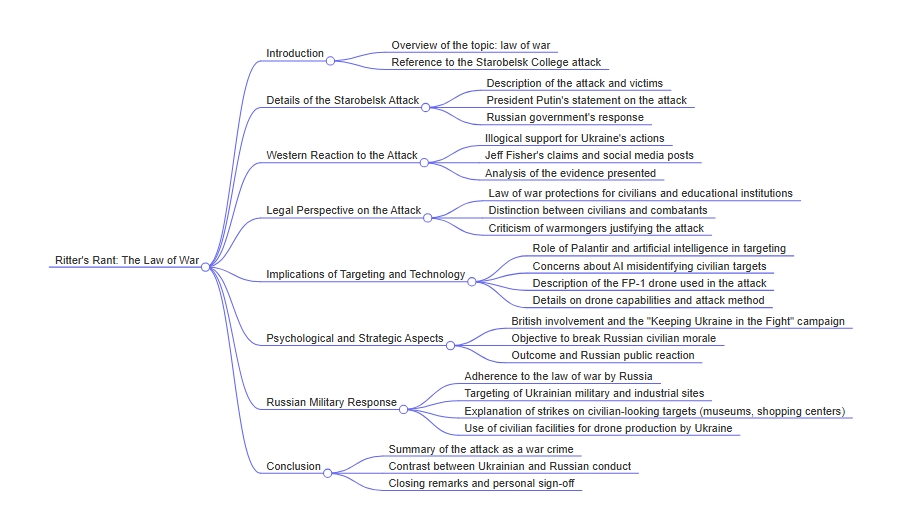
Key Points
A drone attack on Starobelsk College in Lugansk reportedly killed 21 students aged 16 to 18. 00:15-00:40
President Putin attributed the attack to Ukraine, describing it as a deliberate act of murder involving multiple drone waves. 00:40-01:10
Russia announced it would continue strikes against Kiev and advised diplomatic missions and civilians to leave the city. 01:10-01:23
The speaker criticizes Western views that the attack was justified or a legitimate military target, refuting claims that students in military-like uniforms at a competition constituted proof of a military target. 01:42-02:58
The transcript suggests that AI technologies like Palantir might contribute to misidentifying civilian targets as military due to simplistic data processing. 03:46-04:04 06:24-06:55
The attack reportedly used FP-1 drones, described as mass-produced, wooden drones made from Chinese components, some equipped with rockets. 06:41-07:30
Eyewitness accounts and evidence like a Starlink antenna suggest the attack was orchestrated with real-time command and control, involving rocket firings and subsequent drone impacts. 07:48-08:28 08:42-09:28
The speaker claims the attack is part of a British effort to psychologically wear down the Russian people, and that Russia's response strikes Ukrainian defense industry facilities hidden within civilian structures. 00:54-01:41 09:11-10:42
Takeaways
The law of war prohibits targeting civilians, and institutions like colleges are protected civilian entities. 02:58-03:28 04:57-06:12
The interpretation of what constitutes a legitimate military target versus a civilian one is a point of contention, with the speaker arguing against the justification of the Starobelsk attack. 06:02-06:55 10:42-11:59
The use of AI in targeting is questioned for its potential to overlook nuances and misclassify civilian sites. 04:57-05:25 10:42-11:11
The transcript posits that Ukraine is using civilian facilities to produce drones, thereby violating the law of war and making those facilities legitimate targets for Russia. 04:22-05:25 10:24-11:11
The speaker concludes that the Ukrainian strategy of attacking civilian morale has failed, leading to increased Russian resolve to win the war. 04:04-04:33 10:05-10:24
Exploring Diplomatic Solutions for World Peace and Harmonious Living
contact@globalharmony.blog
© 2026. GlobalHarmony.Blog - All rights reserved.